3 Things That Helped Me Stay Disciplined After a 9-to-5 Job
A deeper, honest reflection for working professionals who feel exhausted, stuck, and quietly dissatisfied.
Most people don’t fail in life because they are lazy.
They fail because their best mental energy dies inside the office.
By the time they reach home—around 5:30 or 6:00 PM—their body is present, but their mind is already collapsed. Emails, meetings, targets, comparisons, office politics, pressure to perform, pressure to be liked… everything drains them silently.
So they sit on the bed, scroll their phone, eat whatever is easy, promise themselves “kal pakka start karunga”, and sleep with a vague sense of guilt.
And then the cycle repeats.
I know this because I live this life too. I work a 9-to-5 job. And for a long time, I was stuck in the same loop—wanting to grow, wanting to build something meaningful, but feeling completely empty after office hours.
The question that kept disturbing me was simple but painful:
“If my energy is finished every day after work, when exactly is my life supposed to change?”
Over the last year, through repeated failure, frustration, and self-observation, I realized something important:
Discipline does not break because of lack of motivation.
Discipline breaks because of wrong assumptions about work, time, and rest.
What changed my life were not routines, hacks, or motivation videos—but three mindset shifts.
These are not theoretical ideas. These are corrections I made after paying the price of stagnation.
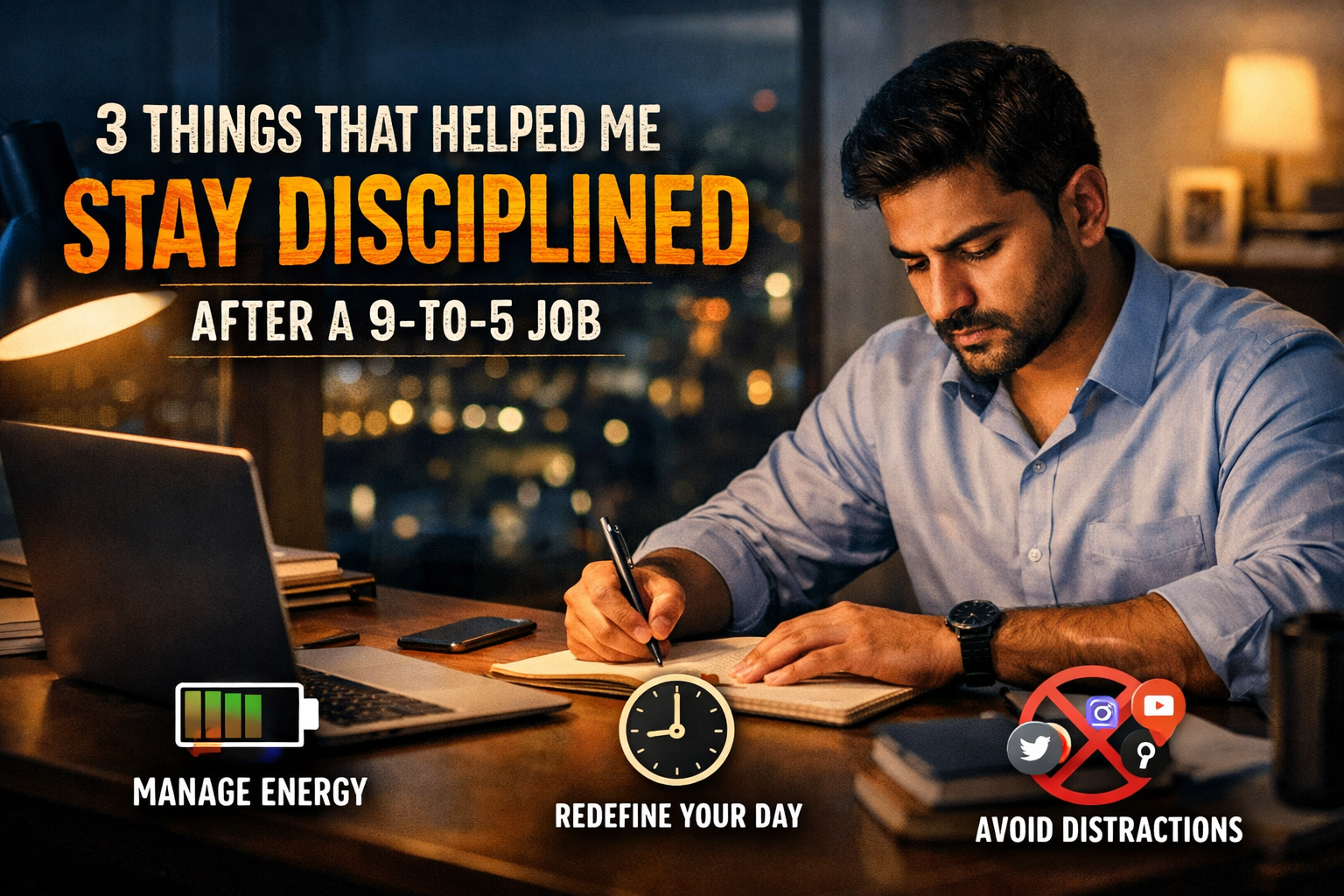
1. Stop Obsessing Over Time Management. Fix Energy Management.
This is where almost everyone gets it wrong.
People say, “I don’t have time after office.”
That’s rarely true.
You might not have energy—but you almost always have time.
From 6 PM to midnight, you technically have 6 hours. Yet most people feel as if they have zero. Why? Because they spent 100% of their mental and emotional energy inside the office.
Office Is Draining You More Than It Should
Ask yourself honestly:
Do you overthink emails? Do you mentally replay conversations with your boss? Do you worry too much about appraisal, recognition, or politics? Do you stretch tasks unnecessarily just to look busy?
If yes, you are not just working—you are bleeding energy.
Treat Office Like a Marathon
Your job is not a sprint where you must prove something every hour. It’s a marathon.
That means:
Work at a steady, controlled pace Focus on output, not appearances Stop emotional over-investment in temporary roles Avoid unnecessary conversations and time-wasting habits
When you work calmly and efficiently, you save 30–40% of your mental energy.
That saved energy is crucial.
Because your real life does not improve inside office walls.
Office pays the bills.
Growth happens after office.
2. Redefine What “The Whole Day” Actually Means
This is the most dangerous mental mistake working professionals make.
“I worked all day. Now the day is over.”
No.
Your job is over.
Your life is not.
If you subconsciously believe that 9-to-5 is the “whole day,” then your evenings automatically become a dumping ground for distractions and excuses.
Life Begins When the Office Ends
The uncomfortable truth is this:
Your transformation will not come from office success alone.
It comes from what you do when nobody is watching.
For people whose lives truly change, the real day starts after 5:30 PM.
That’s when:
Discipline is tested Character is formed Long-term direction is decided
Out of 24 hours:
8 hours go to work You still have 16 hours
Even after commute, dinner, family time, and rest—if you cannot protect 2 honest hours a day for your future, then time is not the issue.
The issue is mental ownership of your life.
Purusharth Begins After Office
In Indian philosophy, there is a word—purusharth. It means conscious effort, striving, responsibility.
Your job fulfills survival.
Your purusharth begins after office.
That is the time reserved for:
Learning new skills Building something of your own Strengthening your mind Creating distance from mediocrity
If you give that time away casually, years will pass—and nothing will change.
3. Mindless Consumption Is Quietly Destroying Your Discipline.
This is the most underestimated problem.
Instagram.
YouTube Shorts.
Random videos, memes, reels, news, gossip.
Individually, they feel harmless.
Collectively, they steal your life.
Not in a dramatic way.
But slowly. Comfortably. Daily.
The Problem Is Not Entertainment, It’s Unconsciousness
After office, your brain is tired. That’s true.
But instead of resting consciously, most people escape unconsciously.
They give their sharpest energy to their employer…
and their weakest, distracted mind to their dreams.
That equation never works.
One Question That Changed Everything for Me
Before consuming any content, I started asking myself one simple question:
“Is this helping me move forward—or helping me avoid myself?”
If the answer was avoidance, I stopped.
Not forever.
Not dramatically.
Just consciously.
Most people don’t fail because they lack knowledge.
They fail because their evenings have no awareness.
They don’t know where their 16 remaining hours are going.
Awareness is not motivation.
It’s clarity.
And clarity alone is enough to change direction.
Final Thoughts: No Motivation, Only Responsibility
Everything I’ve written here comes from my own struggle, not theory.
I didn’t become disciplined overnight.
I didn’t suddenly get more time or energy.
I simply stopped lying to myself about:
How much energy I waste at work How casually I treat my evenings How mindlessly I consume content
Slowly, things started moving.
If you manage your energy, redefine your day, and become conscious of distractions, I can say this with full responsibility:
You will finish what you start.
You will respect yourself more.
And your life will not remain stagnant.
Not because life becomes easy—
but because you finally stop surrendering your evenings.
And for a 9-to-5 worker,
evenings decide destiny.