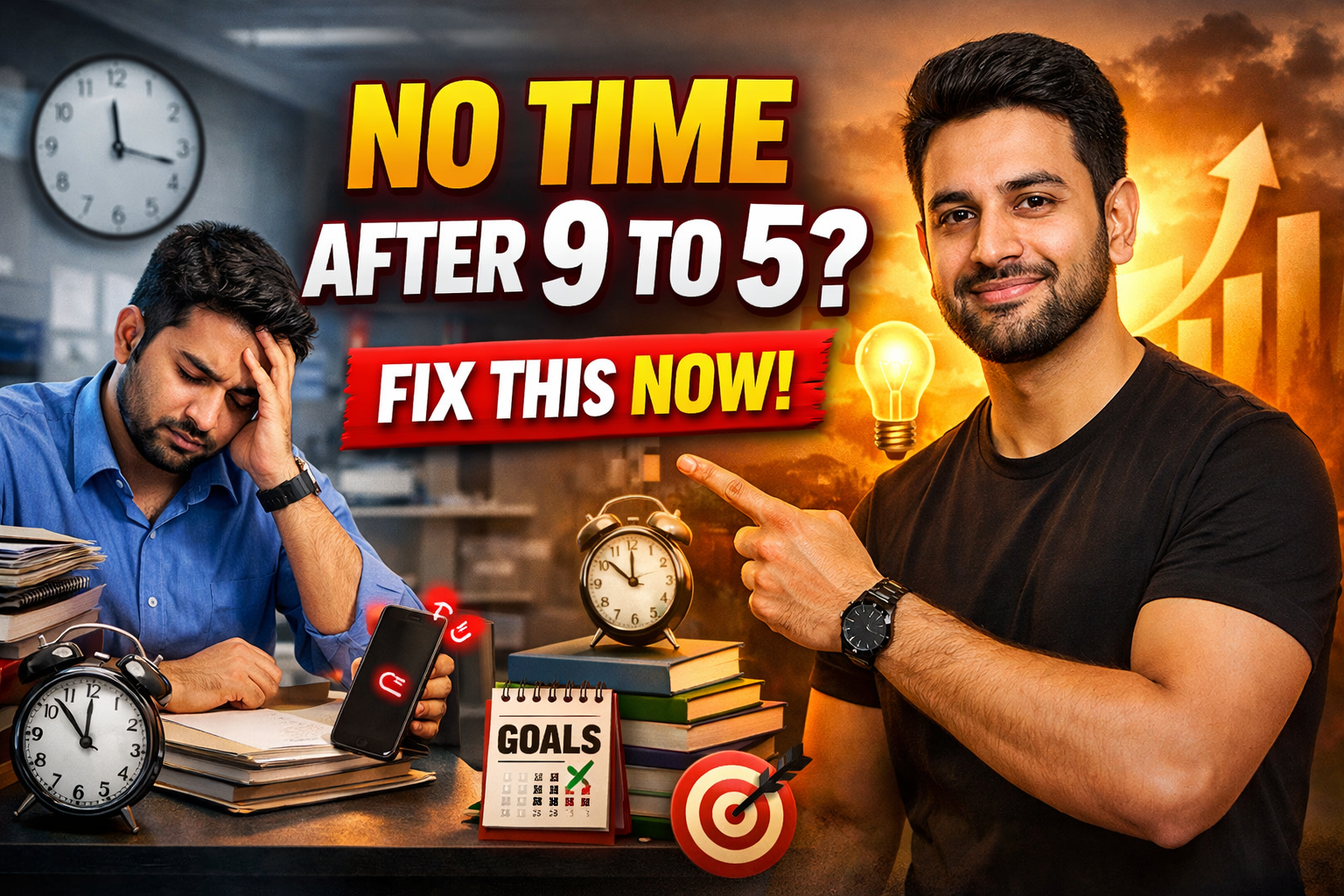
No Time After a 9 to 5 Job? That’s Not the Real Problem.
One of the most common complaints among working professionals is this:
“I don’t get time.”
No time to learn a new skill.
No time to prepare for a job switch.
No time to start a side business.
No time to work on personal growth.
If you work a 9 to 5 job, you’ve probably said this to yourself at least once.
But here’s the uncomfortable truth:
You don’t have a time problem. You have a control problem.
I say this as someone who works a 9 to 5 job myself. There was a phase in my life when I felt stuck, drained, and limited by my job. I believed my schedule was the reason I couldn’t move forward.
Today, I still work 9 to 5. But I also create content, build projects, and invest in my own growth alongside it. I don’t know how many people watch. I don’t know how many approve. But I know this — I’m no longer stuck.
And the difference came down to three powerful realizations.
This blog will break down those three reasons in depth — and if you’re honest with yourself, you’ll see why “no time” is mostly an illusion.
1. You Have Identified Yourself Incorrectly
The biggest mistake 9 to 5 professionals make is not about time.
It’s about identity.
You have labeled yourself as:
“I am a 9 to 5 employee. Of course I don’t have time.”
That label silently controls your behavior.
When you see yourself as a “busy person,” your brain starts finding evidence to justify it. You start believing that only people who are free all day can build something meaningful.
You think:
“If I didn’t have this job, I’d be doing so much more.” “If I had flexible hours, I’d chase my goals.”
But history doesn’t support that belief.
Most successful people did not start with free time. They started with structure, constraints, and responsibility. What separated them wasn’t freedom — it was ownership.
The 24-Hour Reality Check
Let’s break it down honestly:
8 hours at work 2 hours commuting 6–7 hours sleeping
That still leaves 7 hours.
So where does it go?
If you’ve never done a time audit, you don’t actually know.
And that’s the first uncomfortable realization:
You feel busy. But you haven’t measured your busyness.
2. You Are Losing 3–4 Hours Daily Without Realizing It
This is where things get real.
You don’t “lack time.”
You leak time.
Let’s calculate conservatively:
Instagram Reels – 30 minutes YouTube Shorts – 30–40 minutes Random scrolling – 30 minutes Office gossip and unnecessary conversations – 40–60 minutes Mindless phone checking every 20 minutes
That’s easily 3 hours.
Every day.
You’re not exhausted because you work too much.
You’re exhausted because your attention is fragmented.
Your brain never gets depth.
You consume fast dopamine all evening — scrolling, series, short-form content — and then you wonder why you don’t have energy to build something meaningful.
The Easy Dopamine Trap
When you’re tired after work, your brain wants relief.
Scrolling gives:
Instant reward Zero effort No discomfort
But the cost is heavy:
Lower focus Reduced willpower Weak discipline Short attention span
You believe you’re “relaxing.”
In reality, you’re training your mind to avoid effort.
If you reclaim just 2 hours per day, that’s 730 hours per year.
730 hours is enough to:
Learn a high-income skill Prepare for a career switch Build a side project Transform your health
You don’t need more time.
You need awareness.
3. You Don’t Use Your Morning Power Window
This is the most powerful shift.
At night, you scroll the most.
Why?
Because you’re tired.
And your brain wants easy stimulation.
But the morning is different.
Early morning has:
Zero interruptions No incoming calls No social noise High mental clarity
If you use even 2 to 2.5 hours in the morning — say 6:00 AM to 8:30 AM — those hours are worth double the evening hours.
Why?
Because:
Your mind is fresh Your willpower is strongest Your attention is stable Your thinking is sharp
Morning is not just time.
It’s quality time.
But most people:
Scroll until 12:30 AM Snooze the alarm Rush into work Repeat the cycle
Then they say:
“I don’t have time.”
No.
You don’t have discipline around time.
The Hard Truth About Entertainment
This may sound extreme.
But if you truly want to upgrade your life, you may need to reduce entertainment drastically for 2–3 years.
That means:
No binge-watching every new series No endless YouTube consumption No daily dopamine overload
You must choose:
Temporary comfort or long-term growth.
You cannot maximize both at the same time.
Working professionals often say:
“I deserve this relaxation.”
Yes, you do.
But there’s a difference between recovery and escape.
Recovery energizes you.
Escape weakens you.
Most entertainment today is escape.
And escape slowly erodes ambition.
Your Job Is Not the Enemy
The 9 to 5 job is not your enemy.
Your habits are.
If you are undisciplined with 7 free hours,
you’ll also be undisciplined with 14 free hours.
Changing jobs without changing habits changes nothing.
Your environment shifts.
Your patterns remain.
And you repeat the cycle.
A Practical Reset Plan
If you’re serious about change, start here:
1. Do a 3-Day Time Audit
For three days, write down what you do every 30 minutes.
Don’t lie to yourself.
You’ll be shocked at how much time slips away unnoticed.
2. 30-Day Scrolling Detox
Remove social apps or set strict limits No phone in the first hour after waking No scrolling after 9:30 PM
You’ll feel withdrawal.
That’s how you know it had control over you.
3. Fix a Morning Growth Block
Dedicate:
6:00–8:00 AM
This is your:
Skill-building time Career-switch prep time Deep work time Reading and learning time
Protect it like an appointment with your future self.
Final Reality Check
You are not a victim of your schedule.
You are a victim of unexamined habits.
The day you stop blaming your 9 to 5 job,
and start auditing your attention,
your progress begins.
I’m not speaking from theory.
I felt stuck once too.
But the moment I stopped saying “I don’t have time,”
and started saying “I am misusing time,”
everything shifted.
You are not a special case.
You are capable.
But capability without discipline becomes frustration.
So the real question is not:
“Do I have time?”
The real question is:
“Am I willing to control myself for the next 60 days?”
Try it.
And then tell me —
was it really about time,
or was it about comfort?